How to write therapy notes faster without cutting clinical corners
Most clinicians don’t lose time to writing the note. They lose it to starting the note — the blank cursor at 7 p.m., the fourth session of the day blurring into the third, the slow reconstruction of what actually happened before you can document it. If you want to write therapy notes faster, the lever is rarely typing speed. It’s removing the friction between the session and a usable draft, without removing the parts that make the note clinically and legally sound.
There are really only three honest sources of speed: better structure, getting words out by voice instead of by keyboard, and starting from a draft instead of a blank page. Each one helps. None of them lets you skip the thinking. Here’s how to use all three without quietly cutting the corners that matter.
Speed comes from structure, not shorthand
A note format is a thinking scaffold. SOAP, DAP, and BIRP each give you a fixed set of slots, so you’re not deciding what goes where while also deciding how to say it. That separation alone is most of the speed.
- Subjective / Data: what the client reported and presented — in their words and your observations.
- Assessment: your clinical reasoning. This is the part that is genuinely yours and the part you should never rush.
- Plan: interventions used, homework, next-session focus, and any risk follow-up.
A few structural habits that compound:
- Keep templates per modality or population. Boilerplate that’s relevant by default (e.g., a standing risk-screen line for a higher-acuity caseload) saves keystrokes without turning into copy-paste fiction.
- Document the assessment, not a transcript. The slow notes are usually the ones trying to capture everything. The fast, defensible ones capture medical necessity, clinical reasoning, and what you did about it.
- Write to one reader: a future auditor or covering clinician. If the note answers “why this client, why this treatment, why now,” it’s both faster to write and harder to fault.
Structure is also your hedge against the most common failure mode — speed that erodes quality until the documentation no longer supports the care. If the time pressure behind your notes is chronic, the deeper issue may be documentation burnout and pajama-time charting, which structure helps but doesn’t fully solve on its own.
Talk the note instead of typing it
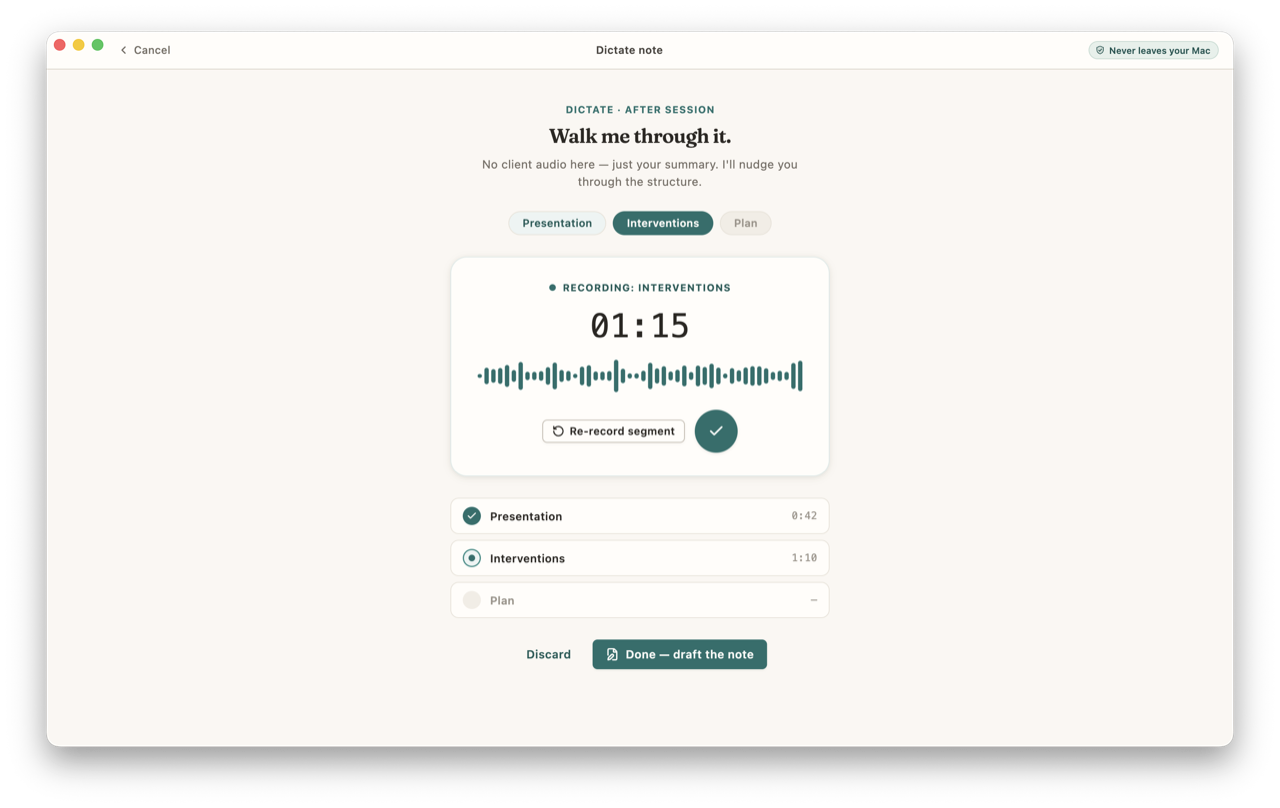
Most people speak considerably faster than they type, and clinical language is already in your head right after a session. Dictating a structured summary — out loud, in your own clinical voice — is often the single biggest time saver available, and it sidesteps the cognitive cost of converting thought into typed prose.
The workflow is simple. After the session, you say the note the way you’d say it to a supervising colleague: presentation, what you observed, your assessment, the plan. The tool turns speech into text; you shape it into the final note. There’s a meaningful distinction here between dictating a summary you compose and recording the live session for transcription — they carry different consent, accuracy, and clinical implications, which we break down in dictation vs. recording therapy sessions.
Dictation works best as a first pass, not a final draft. Speaking gets the content onto the page fast; your edit is where it becomes a clinical record.
Two cautions worth keeping:
- Edit the spoken pass for precision. Speech is loose. “She seemed kind of down” needs to become a documented observation. Voice gets you most of the way quickly; the rest is still clinical work.
- Mind where the audio and text go. Dictation that routes through a cloud service is a privacy decision, not just a convenience one. Processing that stays on your own machine changes that calculus — which is part of why CouchNotes does its transcription and drafting entirely on-device.
An AI draft is a starting point, not a signature
This is where most of the overselling lives, so it’s worth being precise. An on-device model can take your dictated summary (or a recording you’ve consented to) and produce a structured SOAP, DAP, or BIRP draft — slotted, formatted, and ready to read. That removes the blank-page tax and the manual reformatting. It does not remove you.
The draft is exactly that: a draft. You are still the author of record, and the clinically important moves are still yours:
- Verify the assessment. A model can mirror back what was said; it cannot determine medical necessity, diagnostic reasoning, or risk. Read every assessment line as if you wrote it, because you’re about to sign as if you did.
- Correct what’s wrong or missing. Models can smooth over ambiguity or invent plausible-sounding detail. Anything the record can’t support, cut.
- Confirm risk and safety content. Never let a draft be the final word on suicidality, mandated reporting, or safety planning. Those get human eyes, every time.
Used this way, the draft does the boring parts — formatting, recall, getting started — while you keep full control of the judgment. The fast path and the careful path become the same path.
What you should never shortcut
| Safe to speed up | Never shortcut |
|---|---|
| Formatting and section structure | Clinical assessment and reasoning |
| Getting a first draft on the page | Risk, safety, and mandated-reporting content |
| Recalling factual session content | Verifying accuracy before you sign |
| Standing boilerplate that’s actually relevant | Anything you can’t defend to a board or auditor |
A note that’s fast but inaccurate isn’t a time saving — it’s a liability with a deadline attached. The goal isn’t fewer words; it’s less friction reaching the right words.
One product note, kept honest: tools like CouchNotes exist to compress the mechanical parts — local transcription, a structured draft you edit — while leaving the clinical authorship to you. The privacy posture (on-device, no cloud, no accounts, no telemetry, a one-time license) matters precisely because session content is involved, but processing location is a separate question from documentation standards, which still come from your board, your payer, and your own judgment. None of this is legal advice, and rules vary by state and discipline, so confirm the specifics with your licensing board or attorney.
Faster notes are mostly a matter of sequencing: structure first, then voice, then a draft you sharpen. Keep the judgment slow and the mechanics fast, and the 7 p.m. cursor stops being the part of the day you dread. The throughput you gain is real, but its value is that it returns attention to the work that actually needs you — the reasoning, the risk calls, the small clinical decisions a template can never make on your behalf.